Chloe Smolarski
2026 Culture Push Climate Justice Fellow
Chloe Smolarski is an interdisciplinary research-based artist, media maker and educator based in Brooklyn, NY. Her practice combines oral history methodologies, decentralized storytelling and the co-creation of dialogic spaces rooted in memory and ecological imaginaries. Guided by Chris Marker’s words in La Jetée, “To call past and future, to the rescue of the present,” her most recent installation – When Home Leaves You: Archiving Living Memories of Climate Change was exhibited at the James Gallery, Graduate Center, CUNY. The evolving project offered a generative approach to holding space for living memories of climate change. A 2026 recipient of a NYSCA grant, she posits that artists and researchers have a role in helping us regain a sense of agency. Could alternative practices dedicated to remembering, embodied co-creation and the writing of our future imaginaries help create community, fortify our resilience, clarify our strategy?
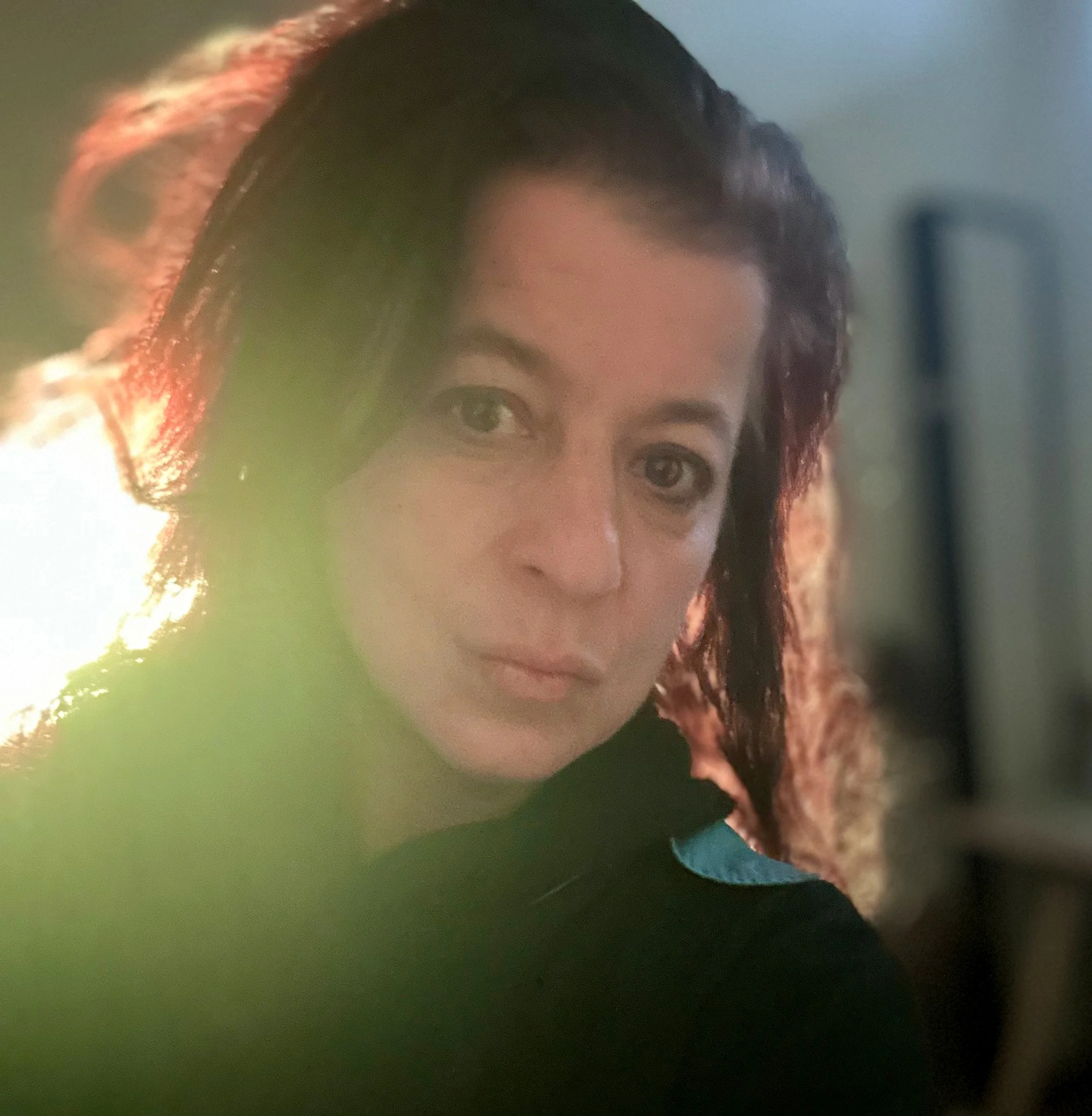
Image description: This headshot is of an European American woman with disheveled hair looking at the camera. The image is backlit and makes her hair glow, orange and casts a slight green light onto her. She is wearing a black sweater and a blue shirt collar is visible. The background shows a bright light on the left and a blurred vertical object on the right.
PROJECT : WORKING WATERFRONT QUILT: SOCIAL ECOLOGIES, AND THE LATENT SPACES OF THE BROOKLYN MARINE TERMINAL
This project blends participatory quilting, place-based dying and the intentional creation of neighborhood, social spaces of cross-pollination, and intersectional dialogue.
This project is situated in Red Hook and examines the Brooklyn Marine Terminal (BMT) through the lens of lived experiences of climate change in the neighborhood. Adaptation and resilience depend on our ability to process the past – and this can only happen if we choose to remember. Neighborhood oral history projects are containers that shape slippery memories, they do so with historical intention and as an act of marking what’s important to us from the past, and with an eye towards the future. Firmly lodged in the complexities of the current moment, the project asks three genuine questions: a) How can we continue to make work about climate change in this historical moment, as democratic institutions designed to address the climate crisis are actively being dismantled? b) How can we create unofficial neighborhood spaces for knowledge-sharing, sensemaking, and future imaginaries in the face of stealth decision-making about Brooklyn’s last working waterfront? c) How can we reconcile the multiple temporalities that destabilize our understanding of climate change while meeting the needs of a constantly emerging city?
La·tent /ˈlātnt/ adjective (of a quality or state) existing but not yet developed
While attending community meetings and tracing political developments, I will engage in an embodied, historically feminized community process: dyeing and sewing a quilt. Botanical and mineral dyes will be harvested from the coastal peripheries of the BMT and collectively sewn during participatory actions across multiple Red Hook locations. These participatory events will foster spaces of semi-structured conversations both historical and speculative in scope.
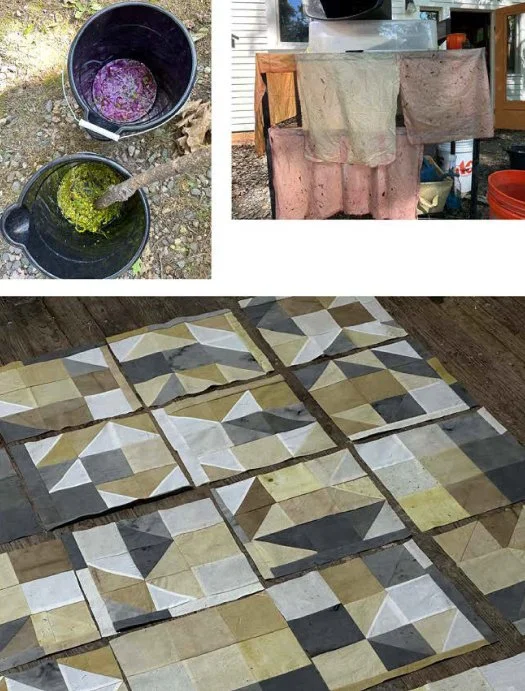
Image description: Three images documenting a natural dying process. The first image shows two buckets. One bucket has yellow flowers (Golden Rod) and a stick in it and the other bucket has purple flowers in it. The second image shows recently dyed cloth hanging and drying in the sun. The third image shows yellow, grey and white quilt squares on the floor being arranged.